
ID: 11111
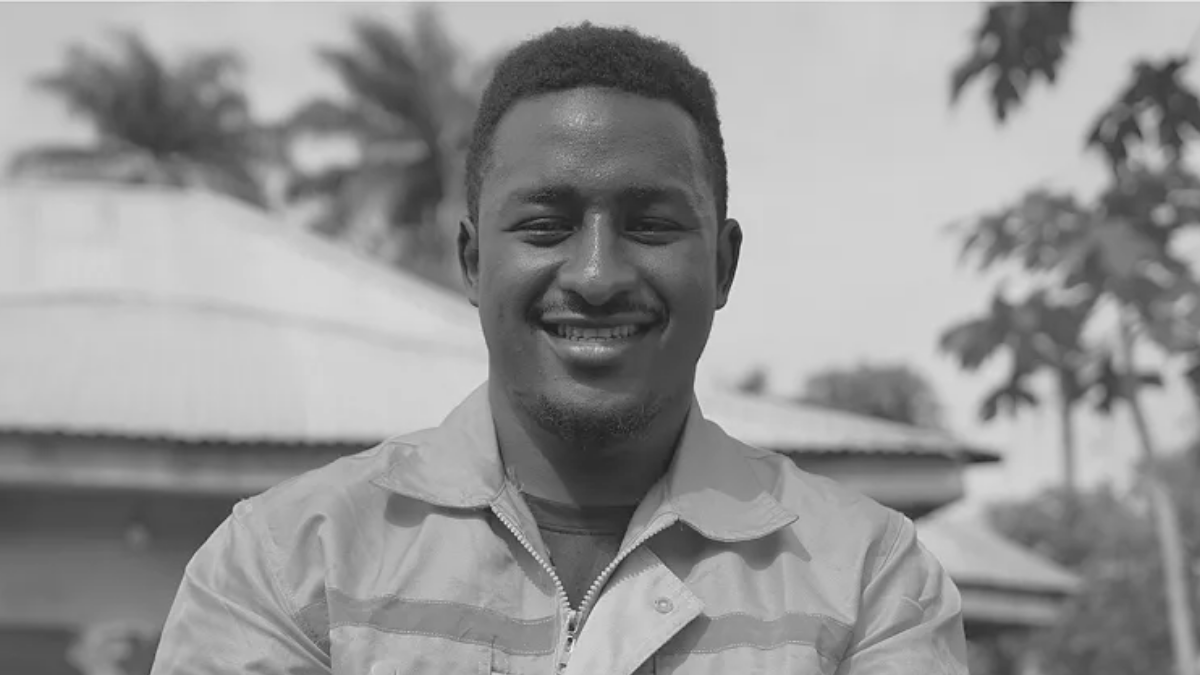
Human : Alhaji Siraj Bah
Location: Freetown, Sierra Leone
Domain: Entrepreneurship, Green Energy, Marketing & Sales
Job Profile: Founder – Rugsal Trading, Climate Change Entrepreneur & Clean Energy Advocate
There is a famous Krio saying, “Watasai ston nכ fred ren” which translates to
“A waterside stone is not afraid of the rain”
Setbacks and challenges are a part of life. It’s a test that everyone has to walk through at some point in their lives. However, there are certain awe-inspiring individuals who transform these setbacks into something incredible.
Our next human in the series has faced many tests in his young life. From ending up in the streets to surviving the 2017 Mudslide Calamity in Sierra Leone, where he lost everything he knew. Yet, he has turned these tragedies into motivation to solve the environmental issues in his community and has been on the quest for clean energy solutions ever since.
So, here’s introducing Alhaji Siraj Bah, the founder of Rugsal Trading, a climate tech entrepreneur and green energy advocate who has been bio-engineering solutions to prevent deforestation and mitigate natural calamities in Sierra Leone. The inventor of bio-bricks from coconut husks, who has become a breakthrough star in the world of Climate Champions, continues to inspire people in his homeland and beyond to find indigenous solutions to tackle environmental issues in Africa and the world.

Bah grew up in a tiny village in the eastern rural region of Sierra Leone, far away from the bustling city of Freetown.
He recalls a poignant memory of his childhood, “I dropped out of school pretty early as I lost my dad when I was 12 and I was living with just my mum.” His situation made him realize that he needed to leave the village if he was to make a living.
“I was not doing anything, but I knew I wanted to be different…I wanted a different life. So, I moved to the capital city,” he admits.
The young 12-year-old Bah had no family or relatives in Freetown and did everything he could to survive. He would work in exchange for food and live on the mercy of good Samaritans. He recalls, “I knew nobody in the city. So yeah, I lived on the streets for a while and did many jobs. I slept on the bridge, on the market…I was fearless because I knew I wanted to be different.”
His efforts finally paid off as a family noticing his hard work and resilience adopted him. After years of struggling on the streets, he had found home.
“So, after four years on the streets, I was adopted by a family who saw me work hard to try and earn a living. They loved me as their own. Things were turning good. By then, I had also found a passion for soccer.”
Having finally found a roof over his head, he got a job at a water factory so he could support his mom, who was still living in the village.
Remembering a distant past, he recalls, “By then, I was around 16-17 years old, and I used to work at the water factory for $1 a day. I would work the whole night and come back in the morning. I did it so I could earn some extra money for my mom.”
And a fateful August morning changed the course of his life forever. “I remember the dates clearly. It was the 14th of August in 2017 when a mudslide occurred in the city, and my whole adopted family was gone along with thousands who were missing…” his voice trails off.
Bah had no choice but to return to the streets; he had to start over again. “I lost everything in a second. But I knew I had to do something different, be a changemaker. It didn’t matter if I was broken or came from a poor family. It shouldn’t stop you from being somebody in society.”
But this time, things were different, and his goal was more than just survival. He became more driven to discover the meaning of his existence.
The mudslide had occurred due to a combination of deforestation and encroachment activities. With his limited savings from the water factory, he decided to start his own venture that would help prevent such future calamities.
He had seen some Indian YouTubers making paper bags from scratch and he was inspired to do the same. “I had $20 saved up from my factory work, and I used it to buy paper crafts to create bags. Every supermarket in Sierra Leone uses plastic, and I wanted to change that,” he recalls vividly. He would go on to create hundreds of paper bags to tackle the plastic waste issue in his city and it also marked the beginning of his foray into the world of business.
Bah fondly recalls his early days in sales, “I didn’t have a workshop or home, I was sleeping on the streets, and everyone thought I had some factory to produce these paper bags. People who have gone abroad, in particular, loved my initiative in using paper.”
Many Sierra Leoneans, both young and old, tired of the existing system, supported the young changemakers’ resolve to fix something broken in their society. After a week, he got a call from another hotel manager who placed an order of a thousand bags.
“Luckily, they gave me an advance deposit for the order, and I bought more papers and glue. I didn’t have a house, so I stayed at a friend’s place and worked 16 hours a day to complete the order,” he tells with excitement.
The order was meant to be completed in ten days, but being highly ambitious and motivated, he finished it in six and proved to the hotel manager how he was willing to put in a lot of effort and hard work in his budding paper business.
“Those paper bags weren’t even good quality, but the manager accepted them happily. When you are so young and you are trying to do something, God is there to help you. And the manager started referring me to different clients,” he recalls his early beginnings.
He was aware that he had to find better ways to solve the energy problem in his hometown. So, he would reinvest all the money he made from paper bags to hire two additional workers to work on his next venture of making bio bricks.
“With additional workers, we could produce bags for shops and supermarkets. Our business was booming, and I saved up everything I could to buy the machines to make bio bricks. But with savings come depreciation, and it has taken quite a while to get here…It has been quite a long journey.”
To raise funds for the next stage of his business plans, the young innovator has expanded his production from paper bags to agricultural products. With accolades and recognition coming his way, he is more determined than ever to discover more sustainable energy solutions for his community and for Africa.


With a changing economic background, the city of Freetown has seen a vast scale of deforestation all over the region. It has led to serious ecological disturbances. He states, “Almost 80% of the trees that are cut down here are for charcoal production, and we have a lot of waste production as well in Freetown. So why can’t we use this waste to produce some clean, efficient and eco-friendly energy source?”
The young Bah spent most of his early adult life researching and experimenting with machinery to create the briquettes. “I did a lot of research to come up with coconut shells for my bio bricks. I even went to welders who work in iron stores to modify how the machinery works. I ended up creating this crazy machine to make my bricks,” he speaks proudly of his invention.
The idea to create bio-bricks from coconut shells and husks came about when he saw how these shells were simply discarded at landfills, and they were found in abundance throughout Sierra Leone. He adds, “I knew these wastes could be transformed to create energy, as a lot of people still use charcoal for cooking here, and these bio-bricks solve the need to cut down more trees. It’s a local solution as coconuts are plenty in my country.”
The world of business was unfamiliar to him, and he admits how he never dreamt of being an entrepreneur who would represent the youth in his country. “I never thought about startups because I had this image where these are people from Harvard, Princeton, the IITs…these smart people. I never even thought of going beyond my country. I was just doing things locally, for my community.”
But the journey has not ended yet, as Bah dreams of bigger things. Among some seasoned businessmen who have made an impact in his life, he names a couple of them and how he would like to follow their example, “I admire the likes of Elumelu from Nigeria, Masiyiwa from Zimbabwe and Ratan Tata from India. These people are entrepreneurs who are giving back to society. I want to be like them in the future and do something for my people back home.”
One of his go-to activities on a day off is to search the internet for stories on young innovators using technology to make a change in their communities. He explains, “There are so many young people doing amazing things in the world. If I can learn anything from their experiences, then I can implement that in my own solutions. That is how I mostly spend my free time.”
His hard work and conviction to succeed have indeed paid off, as his bio-bricks have been featured in popular media channels like Business Insider and have even landed him at Harvard Business School for a start up competition.


When asked what motivated him all these years to keep going on, he says, “After losing my dad and my new family, I did question why so much grief and pain followed me everywhere I go. But I knew the streets cannot be my final destination, I have a long way to go. I was going to be somebody who is responsible for changing the issues I see around me.”
His early memories of his father are bittersweet as he admits the senior Bah didn’t get the right opportunities to have a better life, “My dad was not educated but he was a smart guy. If he had lived in the city, he might have done better things than me.”
He agrees that his father perhaps might have become an inventor or a computer scientist if he had access to the kind of network and support that he has today.
“People know his son now, but maybe if he weren’t from the village, they might know me because of him. But he taught me to be grateful, to be consistent and to work hard,” he recalls warmly.
The inspiration for the name of his company, Rugsal Trading, came from the two people who have deeply influenced him – his dad’s last name Salieu and his mom’s Rugiatu. His mom, Whitney, has been handling the agricultural side of the company while he is travelling and meeting investors in various countries.
He admits, “My mom is super smart, she has been helping me out with my company, taking care of the poultry farms. I have plans to expand my business to different countries like India and Sri Lanka. She has been investing every single money she makes back into the business.”
Besides helping her son out in his venture, Whitney has been a moral compass for Bah, as he explains, “She is always worried if we lose everything again, she is worried about the people…all the people who depend on our business for their livelihood. Some of them are sole breadwinners for their families, and she keeps advising me to reinvest everything to make this company work. We are doing it not only for ourselves but for the community.”
Their resilience has definitely paid off as Siraj has been awarded the UNEP Young Champions of the Earth Award in 2019 and has gone on to be featured in several media publications, including CNN, BBC and the Washington Post, to name a few.


Bah dreams of continuing his incredible journey to change the lives of young Sierra Leonians and inspire them to transform their country and the planet.
“We need to remember that man is not God, we can be broken and lose everything in the blink of an eye. I do believe that God has kept me on earth for a reason,” the past reflecting in his voice.
It is with this conviction that he advises young entrepreneurs to follow their instinct when it comes to making decisions. “The happiest day of my life was getting my first award in the Anzisha Prize 2018, and the reward helped me build my company. I come from a poor country and didn’t really believe I could win it. I saw the competition online and just gave it a shot. My advice is to just follow your gut.”
On his quest to find clean energy, the young climate innovator admits that there is no one solid solution to solve the environmental problems around us.
“Local problems require local solutions, and how you approach a problem in America won’t work in Africa or in Asia. You need something local to help solve real problems. Look around you and help the people with what you have and what you can,” he states positively.
The future holds bigger dreams and promises for the young entrepreneur who wants to dedicate his time to seeking a solution to conserve our planet and prevent similar disasters that made him lose his loved ones. “It’s not just about me; it is not about how much I’m making. It’s about the people behind me and the planet that we are living in, because it is our responsibility to make the planet a safer place for our next generation.”
On the mantra that keeps his inspiration alive, he reveals, “A star shines bright when places go dark. So, no matter what you go through, there is always a place for you to shine.”
Bah’s journey has given us an optimism to see the world in a new light. Through all the calamities, pain and loss, there will always be some stars that lead humanity to a better place.
So, here we are keeping our hopes alive that this young troop of climate innovators in Freetown will continue to triumph over darkness and challenges, find solutions to the pressing environmental issues to save our planet through all obstacles!
This story is dedicated to all the climate warriors everywhere, no matter how dimmed the light gets, there will always be a place for you to shine…